
Required Materials and Tasks
Due July 23 Thursday: Required Readings on Teaching for All Students
Required Readings on Social Justice
- Fish, Stanley. (Jan. 23, 2003). Save the world on your own time. The Chronicle of Higher Education.
- Famous Literary Scholar Fish challenges the teaching of social justice issues
- Bizzell, Patricia. (2009). Opinion: Composition studies saves the world! College English 72(2).
- Famous Composition Studies scholar Bizzell says it is impossible to separate our politics from our teaching
- McCoy, Shane A. (Winter 2020). Writing for justice in First-Year Composition (FYC). Radical Teacher, 116, 26-36.
- McCoy talks about what it means to fully embrace the ideology of social justice teaching
Required Readings on Inclusion and Universal Design
- The Center for Excellence in Universal Design (CEUD)/National Disability Authority (NDA). (Accessed 2022). The 7 principles of universal design.
- The basic concepts of universal design
- CAST. (Accessed 2022). Universal Design for Learning (UDL) guidelines.
- Strategies for making classrooms more accessible for all learners
Class Activities
Act 1: Opening (1 hour and 15 minutes)
The World Needs Saving

Part 1. Journal Writing (20 minutes)
Journal Writing should matter. But so often we make it so “academic” that it becomes boring, that our students don’t care about it. The goal of today’s journal writing is to try to write something meaningful and to think about the value of aiming at that type of writing. All in the context of aiming at a larger goal of working on the problems of social justice.
- I know. You’re not perfect. You’re just one teacher scholar, one IUP graduate student just struggling to pay your tuition bills and earn that degree.
- But the world’s messed up. And it needs your help.
- So close your eyes. Take a few deep breaths.
- I want you to write about compassion. I want you to write about doing good. I want you to write about love. I want you to write about helping others.
- Write a story about someone who really does make a difference in the world.
- Write a story about a great day of teaching you once did.
- Write the story of how you fell in love.
- Write whatever comes to you, even if you’re not sure why you’re writing it.
- Write something down that matters, so you’ll have it for later.
- That will make the world a better place, at least for you.
- And if we’re going to start anywhere with saving the world, that’s the place to do it.
Part 2. Small Group Discussion (20 minutes)
- Talk about what you wrote. There has to be something worthwhile in there.
Part 3. Large Group Discussion: Is it our job to save the world? (20 minutes)
Now you’ve armed yourself with some of your important memories. That ought to help you think about the debate between Stanley Fish and Patricia Bizzell.
- Fish says we have a responsibility to teach students how to write not to teach them moral values. Bizzell says its impossible for us to not teach our values, so instead we should openly acknowledge the values we hold.
- From Stanley Fish’s article:
- “My concern, however, is not with academic time management but with academic morality, and my assertion is that it is immoral for academics or for academic institutions to proclaim moral views. The reason was given long ago by a faculty committee report submitted to the president of the University of Chicago. The 1967 report declares that the university exists ‘only for the limited … purposes of teaching and research,’ and it reasons that ‘since the university is a community only for those limited and distinctive purposes, it is a community which cannot take collective action on the issues of the day without endangering the conditions for its existence and effectiveness.‘”
- From Patricia Bizzell’s article:
- “It will be seen that here I refer to the third way in which composition studies “saves the world,” a way shared with every other academic discipline, namely through contact with the professor’s personality and values. On the one hand, I acknowledge that it is presumptuous of me to bring these values into the classroom, even though I cannot help doing so, and also, by the way, even though I have never found students to be so biddable and easily manipulated as the agitators against so-called political correctness seem to think they are. And on the other hand, like Fish, I believe that my values are right and true. I cannot help but believe so; why would I adhere to them otherwise? Therefore I feel a little less guilty about dragging them after me wherever I go. And I have one additional little solace, which is that I do change my mind in response to persuasion by others—students as well as colleagues can lead me to see things differently, and I can bring witnesses to prove this. So, an ideological tyrant I am not, but, I hope, a humble writing teacher who is helping her students to write better, to analyze various American rhetorics of persuasion, and to reflect—as every rhetorician must do, as Plato, Cicero, and Quintilian have warned us—on the moral, ethical, and political commitments entailed in wielding the tool or the weapon of words” (p. 186).
- Dr. Pagnucci says, “What matters in superhero stories is not the incredible powers or the flashy costumes or the high tech gadgets. What matters is doing good. Superheroes never say, ‘It’s not my job to help this person.’ They help whenever they can even if it costs them dearly.” Perhaps we invented superhero stories because part of us wants to imagine that we would do good if we had the power too. And perhaps that means the actual power to do good is already inside us. Just like all the stories say.”
Part 4. Small Group Discussion: Is it our job to save the world? (20 minutes)
- Who’s right, Fish or Bizzell?
- Or, put less in the either/or mindset of today’s politics, what are our ethical responsibilities as teachers?
- How can we make the world a better place as educators? And should we?
- Can we save the world with our teaching?
Part 5. Full Class Discussion (15 minutes)
- We will have a general discussion about trying to save the world.
Intermission 1 (10 Minutes)
Break (10 minutes)
- We’ll take a short break
Act 2 (1 hour)
Part 6: Theme for English B (15 minutes)
- Hughes, Langston. (1951). Theme for for English B.
- Poem written in 1948 and published in 1951
- Hughes uses the idea of an English writing assignment to explore the topic of freedom
-
Poet Langston Hughes
-
“The instructor said,Go home and write
a page tonight.
And let that page come out of you—
Then, it will be true.I wonder if it’s that simple?” -
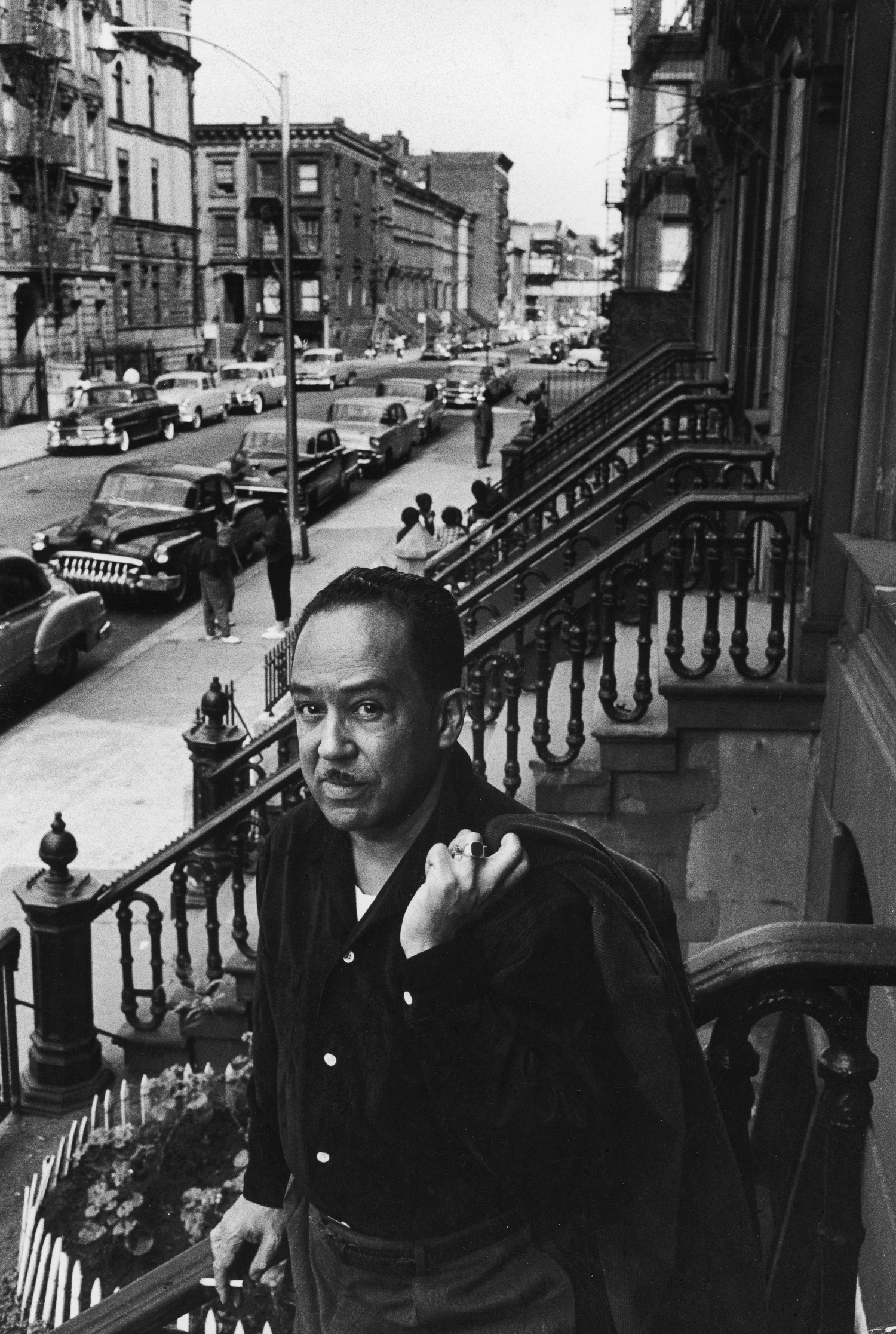
Poet Langston Hughes in Harlem - Video Poem: Morgan, Jaime, & Shorter, Wayne. (2008, May 22). Langston Hughes’ theme for English B.
- Excellent version of the poem set to the song “Footprints” from legendary jazz artist Miles Davis
- Other Video Versions of the Poem
- Video Poem: Gemini, Young. (2019, Jan. 2). Theme for English B.
- Directed by Caleb Neal
- An excellent performance of the poem which captures it spirit nicely
- Video Poem: Jermaine. (Sep. 27, 2015). Theme for English B by Langston Hughes
- Featuring photographs of Hughes
- Video Poem: Albers, Bethany (2017, Apr. 3). Theme for English B digital poem.
- Highlights the words of the poem on key graphics and set to music
- Video Poem: Murrieta, Erica Gomez. (2019). Theme for English B by Langston Hughes.
- Made by 3 high school students
- Video Poem: Manjo, Baby. (2020, Mar. 30). Theme for English B
- Set to guitar music
- Video Poem: Gemini, Young. (2019, Jan. 2). Theme for English B.
Part 7. Journal Writing: A Little Pedagogical Poetry (15 minutes)
What is the language of good teaching?
Make a list
of teaching words,
like pedagogy
or scholar
or guide on the side
or happy and curious but frazzled
and overworked
and underpaid.
What is the look of good teaching?
Describe
how you teachers look
in action,
in class,
in their minds
and at the start of week
or by Friday.
What is the sound of good teaching?
Describe how teachers talk
to motivate students
to do their best
and to help everyone
learn. Tell what teachers say
to save the day.
Part 8. Writing a Group Teacher Poem (15 minutes)
The instructor said
Go home and write
(well maybe you better stay in the classroom)
a page today,
a teacher poem,
if you will.
And let that page come out of you
and your group
as a group
on a page from all of you–
Then, it will be true.
It’s simple, he said,
but they wondered if that was really true.
Part 9. Teacher Poem Sharing (15 minutes)
- Talk about the Teaching Poems
Part 10. Teacher Poem Archiving (15 minutes)
- Please type and send your Teacher Poem to Dr. Pagnucci
- Please include everyone’s name on the poem
- Dr. Pagnucci will create an archive of the poems for the future
Intermission 1 (10 Minutes)
Break (10 minutes)
- We’ll take a short break
Part 11. Overview of Composition Pedagogies (10 minutes)
The Principles of Process Theory
- Donald Murray (1972) outlined the following implications which emerge from Process Theory:
- The text of the course is the student’s own writing.
- The student finds his [or her] own subject.
- The student uses [her or] his own language.
- The student may write as many drafts as necessary.
- The student may write in any form.
- Mechanics come last.
- The writer needs both unpressured time and a deadline.
- A grade finishes a paper the way publication does.
- Each student write must explore the writing process individually.
- “There are no rules…All writing is experimental” (p. 5).
The Principles of Post-Process Theory
- Thomas Kent (1999) explains that there are three primary assumptions about the act of writing agreed upon by Post-Process Theorists:
- Writing is public
- Writing is interpretive
- Writing is situated
Social Justice Pedagogy
- The five key principles of Social Justice Pedagogy:
- Equity
- Access
- Diversity
- Participation
- Human Rights
- Chapman, Thandeka K., Hobbel, Nikola, & Alvarado, Nora V. (2011). A Social Justice Approach as a Base for Teaching Writing. Journal of Adolescent & Adult Literacy, 54(7), 539–541.
- McCoy, Shane A. (Winter 2020). Writing for justice in First-Year Composition (FYC). Radical Teacher, 116, 26-36.
COMIC Book Pedagogy
- This is a new pedagogy that Dr. Pagnucci has been developing in collaboration with a number of IUP doctoral students and IUP alumni
- If you have an interest in using popular culture in the classroom, then Comic Book Pedagogy is for you
- It’s also a good pedagogy for teachers trying to save the world!
- The key principles of COMIC Book Pedagogy are:
- C is for Cool where we use comic books and other pop culture materials to get students excited about learning
- O is for Our Selves and Others where we focus on our Holistic Well-Being
- M is for Multimodal Composing where we help students to use technology to compose in a broad range of forms
- I is for Inclusion where we help students to learn to value diversity and to empathize with others
- C is for Collaborative Learning where we help students to learn and write together
Part 12. Teaching for All Students: Universal Design
- The Center for Excellence in Universal Design (CEUD)/National Disability Authority (NDA). (Accessed 2022). The 7 principles of universal design.
- The basic concepts of universal design
Part 13. The Challenge of Social Justice Teaching
- Snyder, Susan. (2023, Jul. 5). Penn State Abington professor sues the university, claiming he was discriminated against for being white. The Philadelphia Inquirer.
- Zack K. De Piero, a former Assistant Teaching Professor of English and Composition, said “Penn State pressured him to ensure consistent grades for students across “color line[s],” otherwise his actions would demonstrate racism and he would be condemned as a racist, he said in a lawsuit filed in federal court last month. De Piero, who filed multiple complaints with the Pennsylvania Human Relations Commission and the Equal Employment Opportunity Commission alleging discrimination, said he and other white professors were targeted as racist ‘simply by virtue of teaching while “white,”‘ the lawsuit said.”
- From Shane McCoy’s article:
- “Specifically, this framework for writing for justice must entail 1) affective approaches to learning; 2) demystifying of the effects of Empire, colonialism, and imperialism; 3) developing students’ consciousness oriented towards action; 4) creating pathways for successful knowledge transfer, from the learning environment of the classroom to the learning environment of the street; 5) privileging interrogative approaches to learning material rather than prescriptive approaches to learning material; and 6) privileging the importance of empirical research to support and advocate for social justice pedagogies.” (p. 27).
- McCoy’s definition of social justice pedagogy: “What [social justice pedagogues believe] in common is that opposition to hegemony is enabled by critical consciousness; through writing in FYC, I aim to cultivate a student’s critical consciousness, one that is invested in opposing social injustices” (p. 28).
Part 14. Full Class Discussion (15 minutes)
- We will have a general discussion of social justice teaching and the recent law suit
Part 15. Small Group Discussion: The Complexity of Equity (15 minutes)
Social justice is a really challenging subject. So let me ask you to mull over a few hard questions:
- We all have implicit biases. How can we personally address those biases? How can we help students to understand and work past their biases?
- Sometimes scholars use the term “privilege,” but does personal circumstance transform privilege? How privileged is the person suffering from cancer or who just lost a loved one? Less challenging, how privileged is the young man or woman who just had their heart broken by a relationship ending?
- Much social justice work revolves around race, but how do we also help make the world more equitable for people who are different because of their sexual identity, their religion, or physical challenges they may have that no one can see?
- People get othered in many ways beyond the categories scholars routinely discuss. You can be othered because you are overweight, homely, have bad skin, have a birthmark, smell different, or dress in unusual ways. While such challenges might not have the same pervasive effects as racial bias, how can we deal with these challenges in our classrooms? Does talking about such issues detract from the longstanding issues of problems linked to race, class, and gender?
- And, if you’re lucky or just a great teacher, you might be able to spark a really engaged discussion about social justice in your class, which is truly a big accomplishment because, trust me, it really doesn’t happen that often. But as special as such a conversation can be, then what? What happens after that?
- Where do all of these challenges leave us? What should we do as teachers?
Part 16. Journal Writing: Good Deeds (15 minutes)
- Think about a time recently when you did a good act. This might have been something small or big
- Record what you did in whatever detail you can recall. Then describe how the person reacted.
- Now reflect on why you did it.
- Try to think of a second good act you engaged in. Repeat the same writing about that act.
- Do these good acts stand out in your mind or are they hard to remember?
- How can you better put yourself into that frame of mind for doing good in the future?
- Sometimes we know what we should do, but we are too scared or too busy or too embarrassed to do that good deed.
- How do we train ourselves to be consistently, courageously good?
- Think of a good deed you can do today. It can be something small. Write down what you want to do so you don’t forget.
Part 17. Land and Complex History Acknowledgment (10 minutes)
Part 18. Diversity, Equity, Inclusion, and Belonging (DEIB) Sample Statements (10 minutes)
- Many departments now have a DEIB statement that helps explain part of their basic institutional values. Here are some good ones:
- Dr. Pagnucci’s Diversity, Equity, Inclusion, and Belonging (DEIB) Statement (2024)–A more welcoming statement
- Dr. Pagnucci’s Diversity, Equity, and Inclusion (DEI) Statement (2023)–An aggressive early statement
- I want to stress that your statement does not have to match my statement, but I offer mine as one more example
- No DEIB Statement is perfect
- It’s important to acknowledge that although institutions often adopt such statements, they do not solve all, or sometimes any, social justice problems
- Nevertheless, at their best such statements do encourage people to consider what they value and to try to rethink their practices for the better
- In addition, while some people may disregard the statements other people may be glad to hear those statements made
- Such statements have become part of the academic terrain, so they carry weight broadly as an established institutional practice
Act 4: Closing (15 minutes)
Part 19. Class Wrap-up (5 minutes)
- Dr. Pagnucci will take time to go over course assignments and answer any questions
Part 20. Parting Thoughts (5 minutes)
- Video: “What is it to be a hero?”
- This video captures perfectly why it is valuable to teach about superheroes: To encourage our students, and ourselves, to act heroically whenever we the opportunity comes our way; to choose to do good whenever and however we can
- “You don’t need superpowers to be a hero. The only thing it takes to be a hero is the courage to do what’s right when someone needs your help.”–Dr. Pagnucci (June 12, 2023).
Part 21. Go Do That Good Deed!
- Take time today to do that good deed you planned.
- You can do it.
- And, after all, the world really does need saving.
Your Main Assignment!
Due in the Years Ahead: Be a Teacher Who Makes a Difference!
Other Assignments
Due July 27 Tuesday: First Draft of Course Requirement–Course Rationale
Due July 27 Tuesday: Required Readings on AI
AI and First-Year Composition
- Cummings, R. E., Monroe, S. M., & Watkins, M. (2024). Generative AI in first-year writing: An early analysis of affordances, limitations, and a framework for the future. Computers and Composition, 71, 102827. https://doi.org/10.1016/j.compcom.2024.102827
- This article reports on first-year writing assignments using tools such as Elicit, Fermat, and Wordtune, finding that students saw value in AI for brainstorming, sources, counterarguments, and word choice, but often avoided it because of unreliability and the time needed to evaluate its output.
- Vetter, M. A., Lucia, B., Jiang, J., & Othman, M. (2024). Towards a framework for local interrogation of AI ethics: A case study on text generators, academic integrity, and composing with ChatGPT. Computers and Composition, 71, 102831. https://doi.org/10.1016/j.compcom.2024.102831
- This article by our own Dr. Vetter! and colleagues uses a qualitative case study of one composition student’s work with ChatGPT to argue for a “local ethic” of AI use that emerges through classroom-level negotiations among pedagogy, student agency, reliability, access, and academic integrity.
- Graham, S. S. (2023). Post-process but not post-writing: Large language models and a future for composition pedagogy. Composition Studies, 51(1), 162–168.
- Graham argues that fears about AI-assisted writing often rely on an overly linear model of writing, and he suggests that composition instructors can draw on post-process understandings of writing to build pedagogies that engage AI rather than simply prohibit it.
The Environmental Impact of AI
- Zewe, A. (2025, January 17). Explained: Generative AI’s environmental impact. MIT News. https://news.mit.edu/2025/explained-generative-ai-environmental-impact-0117
- The article explains how generative AI systems require substantial electricity, water, and computing infrastructure, leading to increased carbon emissions, water consumption, and other environmental impacts that extend beyond simply using a chatbot.
MLA-CCCC Joint Task Force on Writing and AI
-
- MLA-CCCC Joint Task Force on Writing and AI. (2023). MLA-CCCC Joint Task Force on Writing and AI working paper: Overview of the issues, statement of principles, and recommendations. Modern Language Association and Conference on College Composition and Communication.
- This CCCC/MLA working paper frames generative AI as a major writing-instruction issue, warning against surveillance-heavy responses while urging teachers and programs to develop policies rooted in writing process, student learning, equity, and critical AI literacy.
- MLA-CCCC Joint Task Force on Writing and AI. (2023). MLA-CCCC Joint Task Force on Writing and AI working paper: Overview of the issues, statement of principles, and recommendations. Modern Language Association and Conference on College Composition and Communication.
